What you eat for lunch matters. But what you do in the thirty minutes after your last bite might matter just as much. If you live with type 2 diabetes or insulin resistance, you already know blood sugar can climb fast after a meal, even one you planned carefully. The good news is that a handful of simple, well-researched movements can blunt that rise, some in as little as one to three minutes. As an exercise physiologist, here are the five after-meal moves I recommend most, why they work, and how to fit them into a day that is already full.
Why Your Muscles Can Lower Blood Sugar Without Insulin
Picture your cells as having tiny doors that let sugar move out of your bloodstream and into storage. Insulin is normally the key that opens those doors, and in insulin resistance, that key does not turn as easily, so sugar lingers in the blood longer than it should. Physical activity opens a separate door that does not need insulin at all. Every time a muscle contracts, it switches on a process called contraction-mediated glucose uptake, pulling sugar out of the bloodstream and into the working muscle. A recent review found that activating lower-body muscles, even without standing up, meaningfully improved blood sugar and insulin responses after eating [1]. That idea, muscle contraction as a backup door for glucose, ties every movement on this list together.
The Post-Meal Walk: The Best-Studied Move on the List
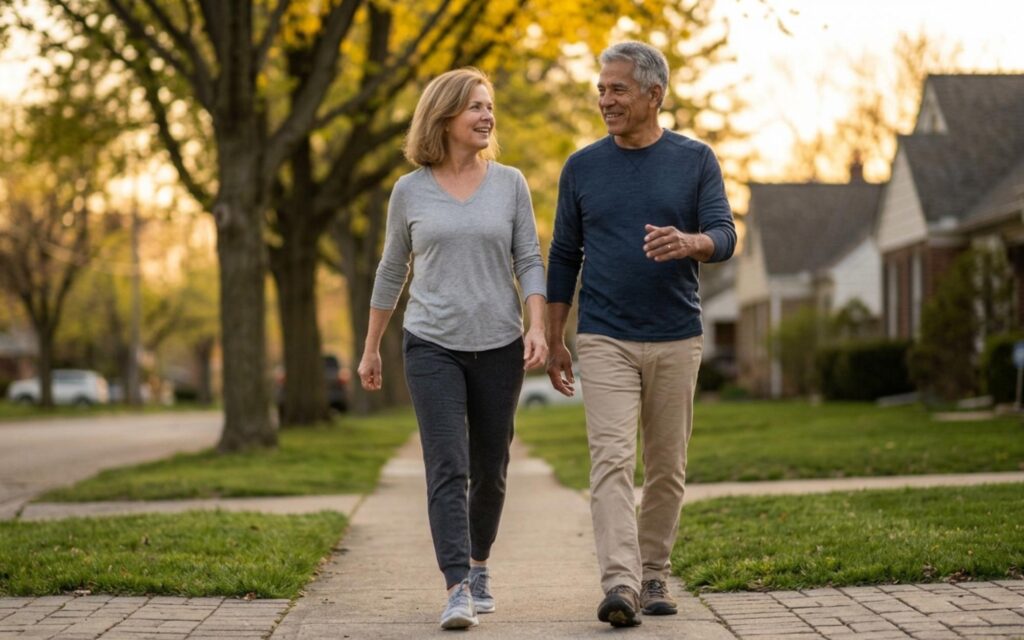
If you only add one habit from this list, make it this one. A randomized crossover trial followed 64 adults with type 2 diabetes and compared two schedules: fifteen minutes of brisk walking after each meal, or one forty-five-minute walk before breakfast. Both groups moved for the same total time, but the results were not close. The post-meal walkers had lower blood sugar readings throughout the day, not just right after eating, and their long-term blood sugar marker, HbA1c, dropped significantly more than in the single-walk group [2]. You can look at the full Pahra et al. trial on post-meal walking if you want the numbers. Your muscles are hungriest for sugar right after you eat, so that is exactly when you want to put them to work. Ten to fifteen minutes at an easy pace, starting within thirty minutes of finishing your plate, is enough to make a real difference.
Squats and Soleus Push-Ups for Busy or Deskbound Days
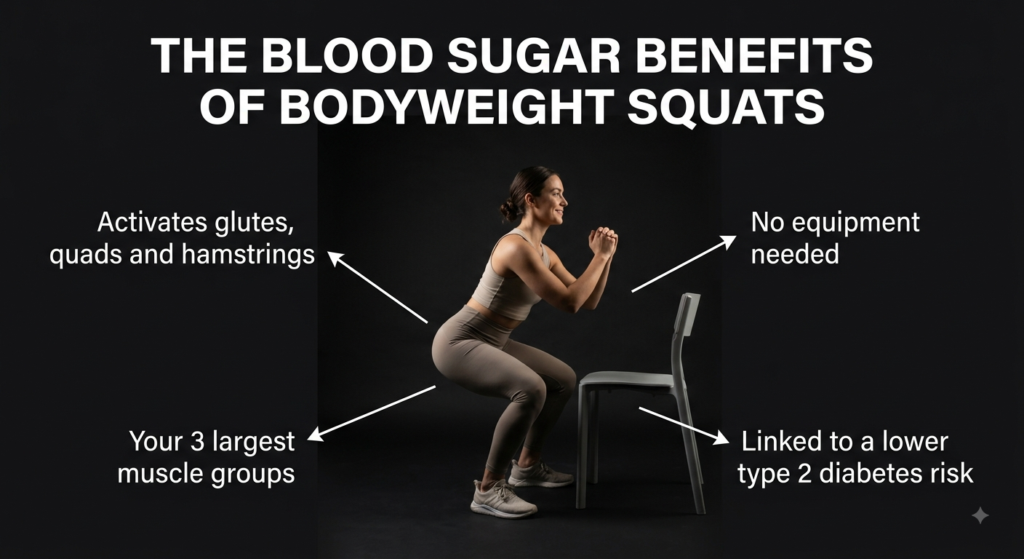
Not every day allows for a walk, and that is where these next two moves help. Bodyweight squats recruit your glutes, quadriceps, and hamstrings, three of the largest muscle groups in your body, so activating them right after a meal puts your biggest glucose-clearing tools to work at the moment your blood sugar is rising. One review even found that greater lower-body muscle strength is associated with a 32-35% lower risk of developing type 2 diabetes [1]. You do not need weights for this. Stand in front of a chair, slowly lower yourself until you lightly tap the seat, then stand back up. Eight to twelve reps for two or three rounds, done within thirty minutes of eating, is plenty.
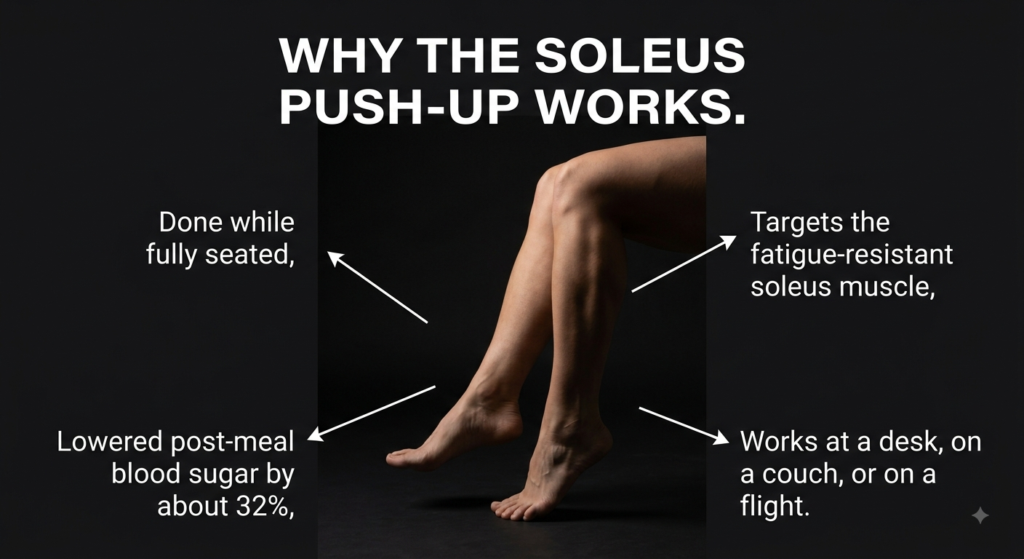
If you are stuck at a desk, try the soleus push-up instead. The soleus is a calf muscle that is unusually efficient at pulling sugar from the blood, even while seated. A pilot study published in the journal Sports had ten adults with prediabetes drink a glucose solution once while sitting still and once while doing slow, continuous seated heel raises. The heel raises lowered post-meal blood sugar by roughly 32% compared to sitting still [3]. The catch is that participants kept this up for two hours straight. But if you are already sitting through a meeting or a show, lifting and lowering your heels the whole time costs you nothing extra.
Stair Climbing and Resistance Band Rows for Faster or Fuller Results
When you want the quickest drop in blood sugar, find a staircase. A randomized controlled trial had adults eat a mixed meal, then either sit quietly or climb stairs for one, three, or ten minutes right afterward. Just one minute of stair climbing lowered blood sugar by about 14 mg/dL, and three minutes did even better, cutting glucose by nearly 18 mg/dL while also improving insulin sensitivity [4]. You can see the full stair climbing trial for the complete results. Stairs work quickly because they combine the same large lower-body muscles used in squats with the added demand of moving your entire body weight, triggering a strong, rapid glucose response.
Pair any of these lower-body moves with resistance-band rows for a more complete workout. Anchor a band around a door handle, pull it toward your torso while squeezing your shoulder blades together, and do eight to twelve slow reps for two or three rounds. Your upper back, shoulders, and biceps hold meaningful muscle mass of their own, and engaging them adds another site for glucose disposal beyond what your legs alone can reach. Combining upper- and lower-body movements after a meal spreads the workload across more muscle tissue at once, which helps on days when you have extra time.
Start With One Move Today
You do not need all five of these after every meal. Pick the one that fits where you are. Just finished lunch at your desk? Try 30 to 45 minutes of soleus push-ups while you work, broken up by a short walk. Home after dinner? A walk around the block followed by ten to fifteen squats covers your bases. Pressed for time? Three minutes on a staircase gets the job done. What matters most is the window between ten and thirty minutes after your last bite, since that is when your muscles are most ready to pull sugar out of your blood. For more ways to build steady, all-day insulin sensitivity, check out our free 10-habit insulin resistance checklist to get started today.
References
[1] Vaishya, R., Vaish, A., Gopinathan, P., & Misra, A. (2026). Non-Weight-Bearing Lower-Limb Simple Resistance Activities, Soleus Push-Ups, and Muscle Stretching: Impact on Glycemic Control and Metabolic-Circulatory Outcomes. Diabetes & Metabolic Syndrome: Clinical Research & Reviews.
[2] Pahra, D., Sharma, N., Ghai, S., Hajela, A., Bhansali, S., & Bhansali, A. (2017). Impact of Post-Meal and One-Time Daily Exercise in Patients with Type 2 Diabetes Mellitus: A Randomized Crossover Study. Diabetology & Metabolic Syndrome.
[3] Elek, D., Tóth, M., Sonkodi, B., Ács, P., Kovács, G. L., Tardi, P., & Melczer, C. (2025). The Efficacy of Soleus Push-Up in Individuals with Prediabetes: A Pilot Study. Sports..
[4] Moore, J. M., Salmons, H., Vinoskey, C., Hooshmand, S., & Kressler, J. (2024). One Minute of Stair Climbing and Descending Reduces Postprandial Insulin and Glucose, with 3 Minutes Improving Insulin Sensitivity, Following a Mixed Meal in Young Adults: A Randomized Controlled Crossover Trial. Journal of Exercise Science & Fitness.

Jose Tejero is an exercise physiologist and two-time Ironman Triathlete. He holds a degree in Exercise Science from the University of Maryland and has over six years of experience working in the field of type 2 diabetes. Jose is currently working towards becoming a Clinical Exercise Physiologist and a Certified Diabetes Care and Education Specialist, combining his two passions: exercise and diabetes care.