If you’re in your 40s or 50s, in perimenopause or menopause, and you keep waking up wondering:
“Why is my fasting blood sugar high when I barely ate last night?”
You’re not imagining it. And you’re not doing anything wrong.
Insulin resistance often becomes more stubborn during perimenopause and menopause, not because you suddenly lost discipline, but because your physiology has changed.
Today, we’re going to walk through what’s actually happening inside your liver overnight, how shifting hormones affect insulin sensitivity, and the four levers that matter most: food composition, meal timing, movement, and metabolic support.
And importantly, how to do this without starving yourself, cutting all carbohydrates, or pushing your body harder than it can tolerate.
What’s Happening in Your Liver Overnight
All night long, your body still needs fuel. Your brain, heart, and muscles don’t shut off while you sleep. To supply that fuel, your liver releases small amounts of glucose into the bloodstream.
In a healthy, insulin-sensitive liver, this release is tightly controlled.
But when the liver accumulates excess fat, it becomes resistant to insulin’s signal to stop releasing glucose. So even though you haven’t eaten, your liver continues dumping sugar into your bloodstream, especially in the early morning hours.
That’s why fasting glucose can climb into the 110s or 120s during perimenopause, even when dinner was light.
The root issue is not late-night carbs. It’s liver insulin resistance.
Why Perimenopause Makes This Worse
During perimenopause and menopause, estrogen levels fluctuate and gradually decline.
Estrogen plays a protective role in:
- Insulin sensitivity
- Fat distribution
- Metabolic flexibility
As estrogen declines, fat storage shifts away from the hips and thighs and toward the abdomen. This increases visceral fat and makes liver fat accumulation more likely.
Visceral fat is metabolically active. It releases inflammatory signals and free fatty acids directly to the liver through the portal vein. Over time, this drives hepatic insulin resistance, meaning the liver becomes less responsive to insulin’s signal to stop releasing glucose.
As a result, the liver continues producing glucose overnight, even when it is not needed. Fasting blood sugar begins to rise.
Sleep disruption compounds the issue.
Hormonal changes during perimenopause often lead to:
- Night sweats
- Early awakenings
- Fragmented sleep
Poor sleep raises cortisol. Elevated cortisol signals the liver to release more glucose.
When insulin sensitivity is reduced and nighttime cortisol is elevated, fasting glucose becomes more difficult to control.
These are predictable physiological shifts during hormonal transition, and they help explain why blood sugar often becomes harder to manage during this stage of life.
Lever #1: Lower Liver Fat (Without Starving or Going Keto)
If fasting glucose is largely a liver issue, the first step is reducing liver fat.
Not by eliminating carbohydrates.
Not by fasting longer.
And not by increasing saturated fat.
A controlled feeding study published in Diabetes compared overfeeding with saturated fat versus polyunsaturated fat. Participants consumed identical calories and gained similar weight.
But only the group consuming saturated fats showed significant increases in liver fat, visceral fat, and insulin resistance [1].
This is critical: the metabolic damage was driven by fat type, not body weight alone.
During perimenopause, the liver is more vulnerable to fat accumulation. That means high-saturated-fat foods (butter, cheese, cream, fatty red meats, coconut oil) can worsen liver insulin resistance even without weight gain.
Reducing saturated fat while increasing fiber-rich whole foods allows fat to gradually drain from the liver.
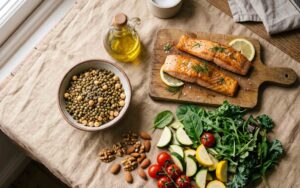
Build meals around:
- Beans and lentils
- Oats, barley, brown rice
- Potatoes and sweet potatoes
- Fruit
- Large volumes of vegetables
This doesn’t require permanent plant-based eating. A Mediterranean-style pattern (high fiber, low saturated fat, moderate lean protein) is often ideal.
As liver fat decreases, insulin signaling improves. Fasting glucose begins to fall at the root.
Lever #2: Eat Earlier — Not Less
Extreme fasting often backfires in perimenopause.
Long fasting windows can increase cortisol, disrupt sleep, and worsen morning glucose.
Instead, gentle time-restricted eating works better.
Finish dinner around 6:30–7:00 p.m.
Avoid heavy late-night snacking.
Eat breakfast within a reasonable window when hungry.
Human studies on earlier time-restricted eating show improvements in insulin sensitivity, fasting glucose, and blood pressure, without reducing calories [2].
The benefit comes from aligning eating with circadian rhythm, not from restriction.
This gives your liver a true overnight rest.
Lever #3: Move in a Hormone-Friendly Way
This is not the season for punishing workouts.
Moderate-intensity aerobic exercise (often called Zone 2) is particularly powerful during perimenopause.
Examples include:
- Brisk walking
- Cycling
- Swimming
- Elliptical training
Studies show moderate-intensity aerobic exercise significantly reduces liver fat and improves insulin sensitivity, even without major weight loss [3].
That matters, because many women see lab improvements before the scale moves.
Aim for:
- 30–40 minutes, 4–5 days per week
- 2 days of resistance training
Lever #4: Berberine as Metabolic Support
Berberine is one of the most studied natural compounds for insulin resistance.
A comprehensive clinical review focused on menopausal women found that berberine improves insulin sensitivity, lowers fasting glucose, and reduces metabolic dysfunction during hormonal transition [4].
Mechanistically, berberine:
- Activates AMPK
- Reduces liver glucose production
- Improves insulin receptor signaling
- Lowers triglycerides
In multiple trials, berberine performed similarly to metformin for improving insulin sensitivity — without forcing insulin secretion.
Most research uses:
- 600 mg twice daily
- Total: 1,200 mg per day
Berberine is not a replacement for food or movement. It works best when layered on top of foundational lifestyle changes.
If you’re on glucose-lowering medication, consult your clinician before starting.
Sleep Still Matters
One poor night of sleep can increase insulin resistance by 30–40% the next day.
Focus on:
- Lighter, lower-fat dinners
- A cool, dark bedroom
- A consistent wind-down routine
- Supporting deep sleep
Consistency matters more than perfection.
Your Perimenopause Roadmap
If fasting glucose is rising during menopause, the strategy is clear:
- Lower saturated fat and increase fiber to drain liver fat
- Eat earlier, not less
- Move moderately and consistently
- Support sleep and stress
- Use metabolic support when appropriate
You’re not chasing numbers.
You’re addressing:
- Liver fat
- Visceral fat
- Cortisol
- Insulin resistance
You don’t have to starve.
You don’t have to fear carbohydrates.
And you don’t have to accept that this is “just menopause.”
You can absolutely lower your morning blood sugar and feel better in your body again.
References
[1] Rosqvist F, et al. Overfeeding Polyunsaturated and Saturated Fat Causes Distinct Effects on Liver and Visceral Fat Accumulation. Diabetes. 2014.
[2] Sutton EF, et al. Early Time-Restricted Feeding Improves Insulin Sensitivity. Cell Metab. 2018.
[3] Keating SE, et al. Exercise and Non-Alcoholic Fatty Liver Disease. J Clin Med. 2023.
[4] Caliceti et al. (2015). Potential benefits of berberine in the management of perimenopausal syndrome. Oxidative Medicine and Cellular Longevity.

Diana is a nationally recognized Registered Dietitian and Certified Diabetes Care and Education Specialist (CDCES), and holds a Master’s degree in Nutrition Science and Policy from the Tufts Friedman School of Nutrition. She received her education and dietetics training from Villanova University, Tufts University, and UC San Diego Health. Diana has over 8 years of experience working in the field of type 2 diabetes.